×
We Value Your Feedback!
If you notice any issues or have suggestions, please share your feedback — it helps us improve your experience.
Sludge Age Calculator
θc = (V · X) / (Qw · Xr + Qe · Xe)
Sludge age θc
-
CurrentTargetScale in days (log)
Solids in tank (V·X)-
Solids wasted-
Solids in effluent-
Total leaving-
Qw needed for target SRT-
Share This Calculator
What is Sludge Age (θc)
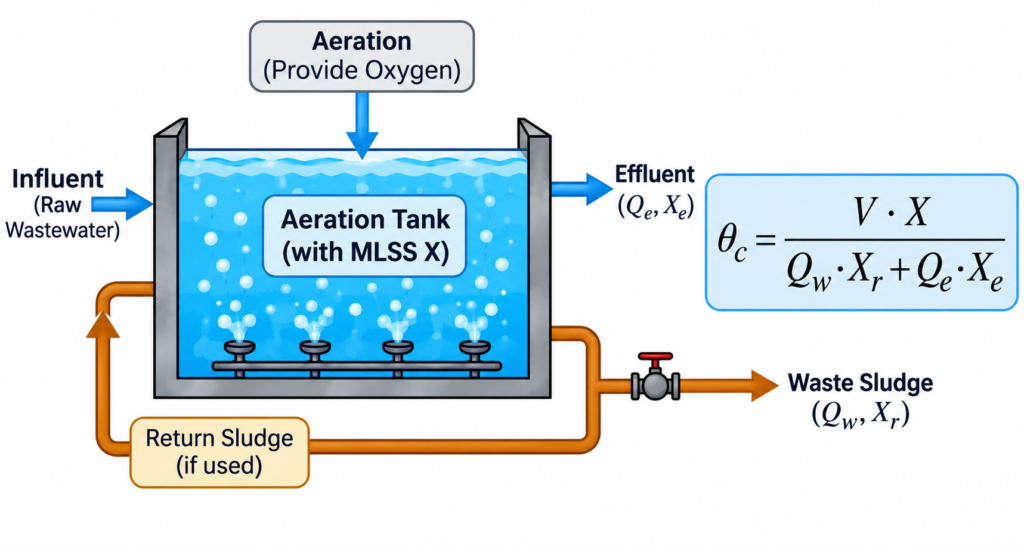
Sludge age is the average time the activated sludge (biomass) stays in the biological treatment system. It is a key design and control parameter in the activated sludge process.
Basic Formula
Sludge Age (θc) = Mass of solids in the aeration tank / Mass of solids removed per day
Detailed Formula
θc = (V · X) / (Qw · Xr + Qe · Xe)
Where:
| Symbol | Meaning | Unit |
|---|---|---|
| θc | Sludge age / SRT | days |
| V | Volume of aeration tank | m³ |
| X | MLSS (or MLVSS) in aeration tank | mg/L (g/m³) |
| Qw | Waste sludge flow rate | m³/day |
| Xr | Solids concentration in waste/return sludge | mg/L |
| Qe | Effluent flow rate | m³/day |
| Xe | Solids concentration in effluent (TSS) | mg/L |
Simplified Formula (when effluent solids are negligible)
θc = (V · X) / (Qw · Xr)
Alternative: Sludge Age from Wasting Directly from the Aeration Tank
If sludge is wasted directly from the aeration tank (hydraulic wasting):
θc = V / Qw
Relation with F/M Ratio and Yield
1 / θc = Y · (F/M) · E − kd
Where Y = yield coefficient, E = treatment efficiency, and kd = endogenous decay coefficient (d−1).
Worked Example
Given:
- Aeration tank volume, V = 2,000 m³
- MLSS, X = 3,000 mg/L
- Waste sludge flow, Qw = 50 m³/day
- Waste sludge concentration, Xr = 8,000 mg/L
- Effluent flow, Qe = 5,000 m³/day
- Effluent TSS, Xe = 20 mg/L
Step 1: Mass of solids in the aeration tank
V · X = 2,000 × 3,000 = 6,000,000 g = 6,000 kg
Step 2: Mass of solids leaving per day
- Wasted sludge: 50 × 8,000 = 400,000 g/d = 400 kg/d
- Effluent solids: 5,000 × 20 = 100,000 g/d = 100 kg/d
- Total = 500 kg/d
Step 3: Sludge age
θc = 6,000 / 500 = 12 days
Typical Sludge Age Values
| Process | Sludge Age (days) |
|---|---|
| High-rate activated sludge | 0.5 – 3 |
| Conventional activated sludge | 3 – 15 |
| Extended aeration | 20 – 40 |
| Nitrifying systems | > 8 – 10 (temperature dependent) |
| SBR / Oxidation ditch | 15 – 30 |
Practical Significance
- Higher sludge age: better nitrification and stabilization, lower sludge production, but higher aeration energy demand and risk of pin floc.
- Lower sludge age: higher sludge production, less stable sludge, possible poor nitrification, and risk of washout of slow-growing organisms.
- Control: adjust the wasting rate (Qw) to maintain the target sludge age.
ADVERTISEMENT